
 | News |
 | Show Times |
 | Albums |
 | Information |
 | Articles |
 | Other Sites |
| Credits |
|
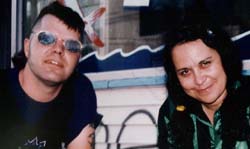
The story of the Leslie Spit Treeo begins at Theatre Direct. This is where they met, doing a play together. They started to jam. And then, "we got a gig at the duMaurier Theatre Festival and then that was it." says Laura. "We were the Leslie Spit Treeo, T-R-E-E-O." This first gig was a big deal. It was two fifty-five minute sets. Fifty-five minutes is the length of their second album. At the time, they only knew, "like, three songs."
They had to rehearse a lot. They also had a dog to walk. So they combined the two. They rehearsed on Toronto's Leslie Street Spit.
After their performance at the festival, they began busking. Perhaps not the pinnacle of their careers. But it was during their busking days that Pat began to believe they could make it, that The Leslie Spit Treeo could be his focus, not writing plays, not professional football.
Later, when they had found their way back inside, they got signed. As Laura explains, "We were at The Last Temptation. The record company came sniffing around, unbeknownst to us. And then called Joe Bamford who was managing Glass Tiger at the time and they were an EMI act. Joe Bamford came along and said 'I can get you a record deal in a year', but he knew he could already, 'cause they'd already told him."
They were signed to a seven-album contract. They were assured that they could grow at their own pace over the course of that contract. Their first album was called "Don't Cry Too Hard". (Laura's roommate, Bob Wiseman, had alredy recorded them singing "The Sound", but it was never released.)
Don't Cry Too Hard was recorded in two weeks. Pat says, "It felt like a blur the day after we finished. It went zooming by. It was nothing like we ever thought recording a record would be. "
There were other problems. Although they don't like to bad-mouth people, if you keep asking questions about Joe Bamford, their manager, you start to get comments like this:
Laura:"He got into buses really big-time. Now he's got a company that supplies buses all across the country for all the other touring bands. He just got more into buses and less into us, so I thought 'It would be nice if we could just stay with Capitol and not have Joe around.'"
Pat:"He would always wait to see what the record company said. It didn't really matter what we said."
Laura: "He did a big divide and conquer. He was right into dividing and conquering the band. Telling us stuff and not telling us other stuff. And using some really bad pop psychology on the band that usually ended up in some disaterous shows."
And then there was Jack Nicholsen. Pat says, "Laura and I spent the majority of our time convincing Jack that he could be in a band. He always felt that he needed to be an actor, and there was a big difference between the two. We really liked having Jack in the band, but for both of us it was like a monkey off our back when Jack decided he'd had enough." (Jack quit the band after their second album came out.)
When "Don't Cry Too Hard" exceeded EMI's expectations, this was a bad thing for the Leslie Spit Treeo. Laura explains, "[A]ll of a sudden they were like, 'maybe we can make some money off of this,' and they forced the issue and we didn't get to grow. It just got nightmarish."
For example, the Treeo had to record the video for "Angel From Montgomery" the day they began their tour. "We were filming 'till like, five in the morning and we got in a bus," says Pat. "And the video crew followed us on the tour. We jumped out at Parry Sound in the bush and we did a bit of stuff and then we wound up in Saut St.Marie that night."
When it came time for the second album, things got worse. "Don't Cry Too Hard" had raised EMI's expectations, and they tripled the budget for the second album, "Book of Rejection". "[I]nstead of twelve days to record," says Pat, "we had two months to record. And another month to mix. And all this money got spent, and the more money they put into it, the less involvement we had in the project. We were pawns in a game at that point."
The nightmare had to end. Jack had finally quit, and Pat and Laura managed to break their contract with EMI. But these were the beginning of dark days for the Leslie Spit Treeo. A Kensington Market restauraunt called Hell's Kitchen was feeding them, but it was a meagre existence. Eventually, they decided to go to Vancouver and start over. They had already sold most of their belongings when they got a phone call that changed their lives. It was Joe Hardy, the man who had produced Book of Rejection. Practically the only person who made money off it. He had also worked with ZZ Top, Tom Cochrane, and Steve Earle. He wanted to record them. For free.
They went down to his place in Memphis. They recorded six songs in his garage. They loved it down there. But when they got back to Toronto, they had some problems to work out. Like the fact that six songs not enough for an album. Like the fact that he had sold most of their belongings.
Ron Searles at Manta/Eastern (a studio) had promised to help them any way he could. They called in his favour, and he did eight more songs with them. They were recorded in three days. They were mixed in two. Joe Hardy told Eye Weekly, "The last record must have cost 30 times more than this one." Jason Sniderman, vice-president of Sam the Record man, lent the Spits the money they needed to produce the CDs, then turned around and bought them for his stores.
The end result doesn't sound a lot like their other albums, and, according to Laura, the reason is simple. "It just evolved that way. It was all about how fast we could make another record." But they came out of the experience with a lot of appreciation for Joe Hardy. "He's an awesome man," Laura says, "and his wife, Trish, is an awesome woman and they helped us out. I think because they got paid quite a bit for mixing Book of Rejection. He used us as his 'giving back to the community bands' kind of effort. It was great. I want to do that again. I'd love to work with Joe Hardy again if we all got paid."
There was another problem with Hell's Kitchen. The artist was listed as "The Spits". Let me provide a little background. Everyone who knows the Leslie Spit Treeo personally calls them "The Spits". But everyone else knows them as "The Leslie Spit Treeo". It seemed perfectly natural to put "The Spits" on their album, since there were two of them, not a trio, and they were used to being called "The Spits". But it meant a huge drop in their visibility, and some people thought "The Spits" was a Treeo cover band. They later re-released Hell's Kitchen with "Leslie Spit Treeo" as the artist.
At this point, they were back to busking, but they found their way into the clubs again. They started running an open-stage called Spit Fridays at The Cameron House on Queen street. One day, some people came up to them after their open-stage. They offered to lend them a few thousand dollars towards production of their next album. This was the genesis of Chocolate Chip Cookies. Of course, Pat and Laura were hesitant at first. When someone wants to lend you several thou, you have to wonder why. But the fans who made the offer just wanted to help. Their only condition was anonymity, and although I think they deserve recognition for their enormous generosity, I will respect their wishes.
(I got involved at this point, first as a fan, then as an open-stage regular.)
I think the open stage had a pretty big impact on their Chocolate Chip Cookies. For one thing, the combined length of both CDs (it is a double-album) is two hours, the length of the average Spit Friday. There are poetry readings and songs by other people on the the album, and a lot of the people on the album were also Spit Fridays regulars.
As Pat explains, "We've always done some kind of open stage thing, whether it was the full band, or just the two of us. We used to do every Sunday at Grafitti's when it was back on Bloor Street. We'd do a set and then we'd have people up, and then we'd do another set. And we did that at the Cameron after that with the full band, on Sundays. It seemed like a good idea to do at the time because we didn't have the album out yet. It's kinda fun to encourage other people to get up there and you get to meet people. It's sort of been part of our history to do something like that."
Chocolate Chip Cookies was their chance to finally do it right. There was no one trying to control them and there was enough time to do it properly. They also had a lot of experience with recording. They filled two CDs. Laura says, "I just wanted to make a normal record, but there were so many songs. Pat is such a little bastard that he's like 'Oh, let's do a double-album because we can.' So we did. And, you know, I don't really regret it." Although if they had the money, Laura notes, they would make a concentrated version also.
In the summer and fall of 1997, they did some heavy touring to support Chocolate Chip Cookies. It's the full band--Pat, Laura, Vince Montago, Shaun Noronha and Jason Reed. Even Dermot Wheelan played with them when they were in town. Pat says touring is lots of fun.
Once they are through touring for Chocolate Chip Cookies, they plan to do a rock musical. "A good one," Pat explains. If anyone is qualified to do that, it is the Leslie Spit Treeo, who met at Theatre Direct so many years ago. Unlike Jack, Pat and Laura can't seem keep music and acting separate. Their first gig was at a the duMaurier Theatre Festival, they performed at the Rhubarb festival in January 1996, and the Fringe festival in July of 1997. If Pat can write plays and Laura can act, and they both can write music, well, let me put it this way: I can't wait to see it.
 | To Top |